
Antipodean Palette 2021

METAMORΦOSIΣ
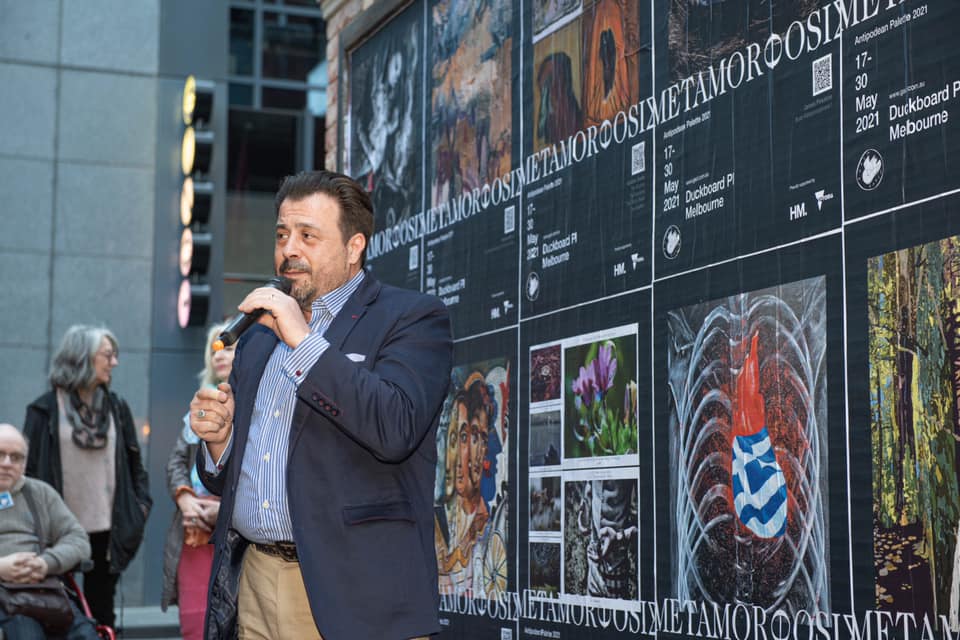
“Change is the only constant in life” a quote by Heraclitus, something we forget and yet is so obvious in today’s COVID climate. After 12 months of insecurity, isolation, for many devastation, and saturated online work, study and interests, the GACL’s 11th Antipodean Palette Art Exhibition is embracing change and exhibiting in a whole new and exciting fashion this year. From Steps Gallery in 2019, to virtual in 2020, it is now in 2021 on the streets of Melbourne. Posters showcasing 14 artists’ work will be displayed on outside billboards and city walls.
The main site, is a wall in Duckboard Place —centrally located within the street art trails of Melbourne’s CBD— as well as randomly placed posters within the city and several surrounding suburbs. The ‘exhibition’ can be viewed anytime from 17 to 30 May 2021.
The theme ‘METAMORΦOSIΣ’ was chosen to align with the central idea of the 200 years of Independence of the Republic of Greece from Ottoman rule. But it is so much more than that. It is about change, about adapting, about moving forward.
In this exciting new collection of work presented by the GACL, 14 artists approached the theme of “Metamorphosis” in very different ways: there are personal stories, passionate connections, transformational ideologies, and surprising perceptions. The different approaches in which each artist has interpreted the theme displays both the complexity and acceptance of change. This eclectic and disparate body of work displays insights into the human condition and changing circumstances, and in turn provokes us to interpret the artists’ work at a personal level.
‘Antipodean Palette’ 2021 Artists
Thalia AndrewsJust as the butterfly metamorphose through its life, from the beginning travelling as a caterpillar then the miraculous creation turning into a chrysalis continuing with the unique transformation and true-life purpose to become a majestical butterfly. We too as humans’ metamorphose through life from birth, to childhood, to adolescence, to adulthood. Each and every one of us has an individual and tempestuous journey. The colours, tones, textures and strokes utilised reflect the depth and meaning of the trials and tribulations which are expressed in the journey of the butterfly’s life throughout this painting. The luminosity and radiance from the centre point of the painting creates a feeling of tranquillity and peacefulness along with the release of one’s inner self and deeper thoughts. The artist’s touch, applying paint to brush represents wonder and appreciation for the beauty of the world that surrounds us. The metamorphosis of the butterfly goes hand in hand with the artist’s contemporary expressionistic style; First is the painter’s interpretation, followed by the viewers.

Price: $450
Follow Thalia Andrews
George AthanasiouThe painting was initially an exaggerated drawing of my hand. I never know what I’m going to get when I paint. It just evolves from an imagined snapshot in my mind. A hand becomes a group of buildings, born out of the earth that gives rise to a community of people. What kind of a community is it? What kinds of people are represented here? The hand/building that emerges out of the sandy earth represents the building blocks of civilisations, their decay through dictatorship and censorship, and their renewal. The colours used here represent the changing face of lands and peoples, both freed and oppressed. It also represents the blood and toil spilled from those who built these places. Are these buildings the hallmarks of a better world or a bitter one? Are the people who live here builders or destroyers? Or does this picture represent the iron hand of oppression about to be clenched into an iron fist? That depends on the leaders we elect and the causes we fight for. Democracy and self determination remains fraught as civilisations rise and fall, from Aboriginal Australia to the Greek War of Independence. Are we right to guard the values we have when we are but a few steps away from dictatorship and totalitarianism?

Follow George Athanasiou
Efrossini ChaniotisONE EYE is my gesture of respect for the legacy left by Greece to the history of art. I also created it to demonstrate the golden thread that remained throughout the changes that took place over time.
METAMORPHOSIS when applied to art can be argued- is not lineal. Great work, insights, developments are not guaranteed into the future. Yes we are handed the baton’, but if we do not look back, marvel, ponder and learn from the ones who started the race we are poorer for it I think.
From the earliest expressions of the human figure, Greek artists have ‘passed the baton’ on to the next generation of artists.
As I painted it I recalled what I had learnt about painters from the pinnacle classical period of ancient Greece. Artefacts were all lost apart from written accounts by their peers. The only visual examples were of what survived in later centuries in the form of frescoes, and by the work of Greek painters in Roman times, who were the descendants from those traditions.
Through lines, shapes and particularly the constant witness: the benevolent ‘EYE’, this painting represents some the great movements in art and cultural milestones in Greece’s history. For this artwork I chose : CYCLADIC, CLASSICAL, ARCHAIC, FAYOUM (Roman-Egyptian) BYZANTINE (Cretan school) , TSAROUHI, FASSIANOS (Both great modern Greek artists who studied at the Athens School of Art and left their mark on me ) AND MINOAN CULTURE.
I have also included my own stylised black and white owl in the painting ,which is a copy from an old artwork, to indicate my personal recognition and respect for the impact and vitality that the artistic heritage of my homeland has on my work.

Price: $1,250.00
Artist ProfileEfrossini Chaniotis is a Greek-Australian sculptor, painter and storyteller whose unique style uses striking color and composition, with influences from sacred Byzantine iconography, folk art from diverse cultures, and bold modern art. Her themes are inspired by myth, history, cultural heritage and the every-day, using imagination to tell stories of the human spirit. Efrossini’s arts training includes international studies at the South Australian School of Art, the Madrid School of Fine Art, and the Athens School of Fine Art, as well as a master degree in Art Therapy. She regularly exhibits in group and solo shows and her paintings and sculptures are held in private collections throughout the world. Efrossini has created murals and street art for community groups, council projects, private, and commercial clients. In 2019 Efrossini won the Gippsland Sculpture Prize with her unique brand of painted, mix media, figures which admirers have compared to Mirka Mora’s soft sculptures. As a contributor to the thriving Melbourne street art scene Efrossini’s work was also included in the book: ‘Burn City’ by Lou Chamberlain, showcasing local Melbourne Street Art. The artist currently works from her Little Mykonos Studio in Melbourne.
Follow Efrossini Chaniotis
Konstantinia GogouPainting for me is in its essence transforming our emotions and ideas into colour, shapes and images; a metamorphosis. I consider my work to be a study of the world around me and the emotions that come with it, especially the ones I do not fully comprehend, as it is curiosity for the unknown that’s pushing me forward and helping me change and evolve. When the theme for this year’s exhibition was announced the first thing that came to my mind was my ongoing pregnancy. It clicked gracefully inside me as in this very moment I am going through a complete physical and emotional transformation that is as natural as is extraordinary. That’s why I decided to paint a self-portrait depicting the metamorphosis of my body, nurturing a new life, a new soul, soon to come into the world. My main goal is sharing this very intimate moment as a woman becoming a mother for the first time and as a painter observing the day-to-day changes on my own body and translating that information on the canvas. For this painting I chose vibrant warm colours for the background to represent life and lilies to symbolise fertility, femininity and rebirth. I painted myself in black and white to highlight my newly acquired curved figure but also to keep it timeless, kind of how an old photograph holds just a fleeting moment in time.

Artist ProfileI was born in 1990 and grew up in Greece and migrated to Australia four years ago. My fondest memories of my life are the vast mountainscapes of my hometown and my mother painting, and that’s where I draw my inspiration from. I am a self-taught artist and creating art is my way of finding my inner peace, balance, expressing my emotions and connect with my memories on a visual level.

Follow Konstantinia Gogou
Aphroditi KaralisDeath, the final stage of metamorphosis -Or is it? My experience with death began as a 3 year old when my grandfather had a stroke, ended up in a coma and died soon after. I don’t remember this at all. I only remember stories from my parents about my grandfather’s final moments in a hospital all alone. In 2015 I watched my cousin be ravaged by cancer. I would bring her flowers and sit by her bedside -a hospital bed set up in her lounge room. In the latter stages of her illness I remember trying to communicate with her, but after numerous operations to remove brain tumours, her memory had partly been lost together with her speech. The vibrant, beautiful, living being had been destroyed and I was there to witness it. I will always remember the horror. But it was my brother’s shocking and incomprehensible murder that changed my life. It changed my sense of place in the world. I had been the oldest child in our family and then I became the only child. This, I wanted to forget. Time, memory and the intangibles are themes that run through my work. In this piece – I have photographed a human skull on a reflective surface almost like an autopsy table. There are no heavy dark shadows in this image – only a single splash of light. The skull is a training tool borrowed from a doctor. Anatomical names are written on the surface in scrawny handwriting. Brain matter no longer exists in this structure and yet memory appears to hover. The skull belonged to a woman in her fifties.

Follow Aphroditi Karalis
MasonikThis work considers the fleeting nature of thought. The philosopher contemplates an abstract ideal, the form and structure is discovered through introspection, a fundamental geometry which exists only in the mind. The discovery is simultaneously an emerging idea and a mutation, constantly subject to transformation, as thought cannot be static. Multiple concepts captured in a single moment, as all thought exists in a dream-scape flow of time. Hoping to conquer the transience of thought, the philosopher might consider permanence, although that thought is also fleeting. And so we turn to “Representation” for a fix, even understanding that any manifestation is subject to time and change. Witness the weathering of street art. The same problem is captured by the medium of photography, a transformation of light into image, here represented in all its forms. Traditionally used to capture a moment in time, a ‘fact’, here it is layered, manipulated, the meaning partly hidden and partly transformed, duplicated and obscured. The work itself is a demonstration of transformation, recursive through the nature of representation: while form and structure can be captured in a snapshot, the idea they manifest is always changing. Even facts are, in the long term, impermanent. Imagine what might happen to an idea in art?

Price: $500 -includes a copy of Masonik’s vinyl record release of “Stable/Destroyed”
Artist ProfileMasonik is an Australian multi-disciplinary arts collective, who have performed nationally and internationally since 2006. Masonik’s immersive experience creates electronica / new-fusion / neo-classical and soundscapes layered with video projections. As Visual Artists, Masonik generates artworks based in graphic design, film, photography, sculpture, installation and theatre.


Follow Masonik
Maritsa MicosThe metamorphosis of Navarino Bay depicts both the defeat and victory of the last major naval battle in history, fought entirely with sailing ships. (during The Greek War of Independence, October 1827) Small abstract sailing ships appear lost and fragile, engulfed by both the sky and sea. There is an uncertain feeling of what is ahead, and a metamorphosis is taking place, through the abstract process Navarino Bay is beginning to change. The many impasto layers are symbolic of turmoil and confusion, revealing the deconstruction that is happening in the bay. The upper right-hand side corner posts a subtle cross that underpins the Greek people’s enduring faith, an important fact that carried their resilience and drive. The battle at Navarino Bay proved to be a turning point for today’s town of Pylos on the west coast of the Peloponnese. Without it, it may not have gained its independence.
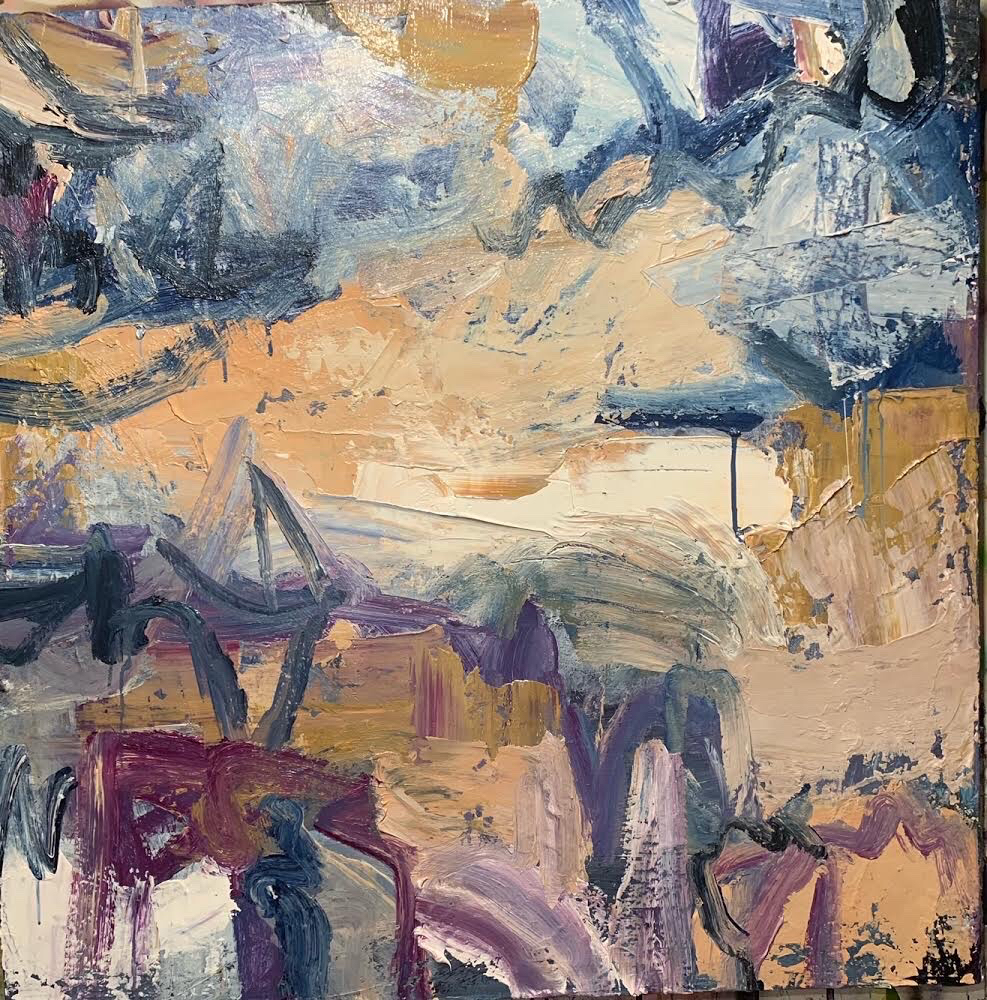
Price: $2,100
Artist ProfileMy artwork draws energy and inspiration from the land in its many forms, The layers of impasto and graffiti like marks are evident within my contemporary mixed media palette which comprises of acrylics, aerosol, collage, gouache, ink, graphite. Artists such as De Kooning, CY Twombly and Aida Tomescu have influenced my style.. The process of mark making became my focus when I joined the Drawing Marathon in Soho NY and worked under mentor Graham Nickson. The vocabulary of drawing crossed the boundaries of paint and my personal style broadened through unorthodox tools and exercises. As a result my art process became intuitive in its approach.

Follow Maritsa Micos
James PasakosPart of an ongoing series portraying the Docklands, Pasakos continues the narrative of travel and discovery in new works. During recent travels overseas he has often considered the valuable migrant stories of travel. The boat is a metaphor of travel, its iconography, symbolism of the artists memories of the past and the present. It represents time, change and the blending of the two worlds he identifies with and belongs to. New works are continuously unfolding, they reflect powerful experiences as they act as reminders of the fragility of our sense of self in the world, and the way in which that sense of identity may develop and spawn new cultural identities that change or shape values of other cultural frameworks. New and ongoing works that have developed explore travel, memory, identity and belonging for Pasakos. Greek and Melbourne Dockland iconography metamorphosis into landscape images that appear dreamlike, surreal and mythic. Iconic landscapes are depicted from the island of Kos, Greece where his parents were born, they serve as a metaphor for a mysterious journey and a portal of a sense of place and transformation.

Follow James Pasakos
Virginia PolendakisThis mythical creature has the head of a woman, eyes and body of a puma, the wings and green plasma of a butterfly. She stands above the thorns of branches in the background which reflect our layers of armour as a means to protect ourselves from predators as we reach out to the light. The butterfly represents the inner fuel for change and transformation. The experience is a courageous journey through elements, the disintegration of self, the alteration of form, and the struggle to be free to fly. For Greece to emerge from the rule of the Ottoman Empire, it involved a process of restriction, struggle and transition. Years of suppression and culminated tension that ran through the veins of an ethnos produced the drive for the green plasma to be pumped and squeezed through its untested wings. Without this process, there could be no uprise and thus no flight for Greece. We must experience the struggle at some point – or we will not be strong enough to fly. Greece, like the puma, became the huntress with singular focus. Together with her allies, She strikes with precision and effectiveness. Puma is about coming into your power.

Price: $20,000
Follow Virginia Polendakis
Katerina PriftiThe painting is named after a verse from the Greek National Anthem also known as the Hymn of Liberty, who’s powerful stanza declares that we have arisen from the sacred bones of the Hellenics.
Inspiration of this piece came during the artists visit to her specialist, when he brought up on screen an x-ray of her sternum. The x-ray showed the spine, rib cage and a shadow outlining the heart. Instantly she was reminded of the verse in the National Anthem and wanted to bring the poets words to life by tantalising the observer’s visual sensors, so they too could see through her eyes. At that moment she was not staring merely at an image of bones but rather the DNA of her ancestors, which like a carefully orchestrated ladder took her into an attic were all the precious memories of the glorious and painful past were hidden. The bones of resilience that held a nation together maintaining its unique identity and a heart on fire yearning for freedom and paying the ultimate price to achieve it, it’s blood.
Like the x-ray, the contrast of black and white helps the main character the bones, take centre stage. The heart is red to illustrate the fire that is burning within it. The red of blood resembles our ancestors sacrifice and finally the Greek flag within the heart. The Greek flag appears to be streaming in the wind while caressing and moulding around the shape of the heart. The artist has done this to illustrate our turbulent past, the Hellenic free spirit and that at the base of our heart lies our flag which epitomises our values.
Metamorphosis is the process of something taking on another form. In geology for example, during the process of metamorphosis the original rock (protolith) changes to a new type of rock without losing the properties of its original state. In fact, Metamorphic rocks are classified by their protolith (original rock). Here the image wants to portray just that. Whilst we may change over time, at the core of our structure we remain true to our original state. For Hellenes this is has happened many times during our history, from surviving 400 years of Turkish rule to the great waves of migration. Many Hellenes now call Australia home and have embraced this land and its values. While generations to come will inevitably adapt and change even more, one thing is for certain; no matter how much metamorphosis occurs the Hellenic DNA cannot be removed from their bones.
Some rocks may change completely with time and pressure, Hellenes will not.

Artist ProfileI was born and raised in the picturesque town of Kouvaras located in the Province of Eastern Attika, approximately 40kms outside of Athens. The town is built on lush green hills, surrounded by endless views of Greece’s famous beaches and islands. In such an inspiring environment it was only time before my artist nature surfaced and developed. In 2003 my love for art led me to the atelier of internationally acclaimed artist Antonios Politakis, who took me under his wing. For five years I studied Art and Art History alongside him. It was he who gave me the passport to the endless journey called Art. Over the years I have participated in and organised many personal and group exhibitions all over Greece. A highlight of my career was being invited to exhibit my work in an exhibition named “Greece’s Best Modern Artists”. I have been very fortunate to witness my work been displayed in government and private buildings, join the collection of well-respected Art Collectors, and grace the walls of folk who simply had an appreciation for the arts. Since arriving to Australia in 2014, I have dedicated my time to my family and raising our children. However, during this time I did not entirely stop working. I presented my work in a personal exhibition named “Looking Forward”, participated in the 2017 Antipodean Palette, and commissioned two unique pieces. As 2021 dawns, I feel rather excited as I embark on a new journey to reignite my art career, start working on new pieces and become more active in the arts community. Antipodean Palette 2021 was the impetus for this new beginning. My exhibit named “Apo Ta Kokala Vgalmeni” (from the bones arisen), commemorates the 200 years of Greek Independence while attempting to bring to life the lyrics of the Greek National Anthem. I hope that you find my work inspiring and that it speaks to you in a way that you too may embark on the endless journey called Art.

Follow Katerina Prifti
Helen SartinasI am Helen Sartinas and am an artist, sometimes. I like to use photography and digital media to tell stories. I am particularly interested in exploring themes of identity and place and the relationship in between. This piece is the opening of a six part sequence where I try to deconstruct the idea of identity through the symbol of the Stoli – the Greek National Costume. It begins with the image of the subject sleeping. However she could also be dreaming. We are not sure whether her state of dreaming is an illusory manifestation of a past life. The aim of the work is to represent the connection between identity and memory making. Nostalgia plays a big part in shaping identities for those who come from a diaspora community. The past is recontextualised in the present – always imminent and always undergoing change.
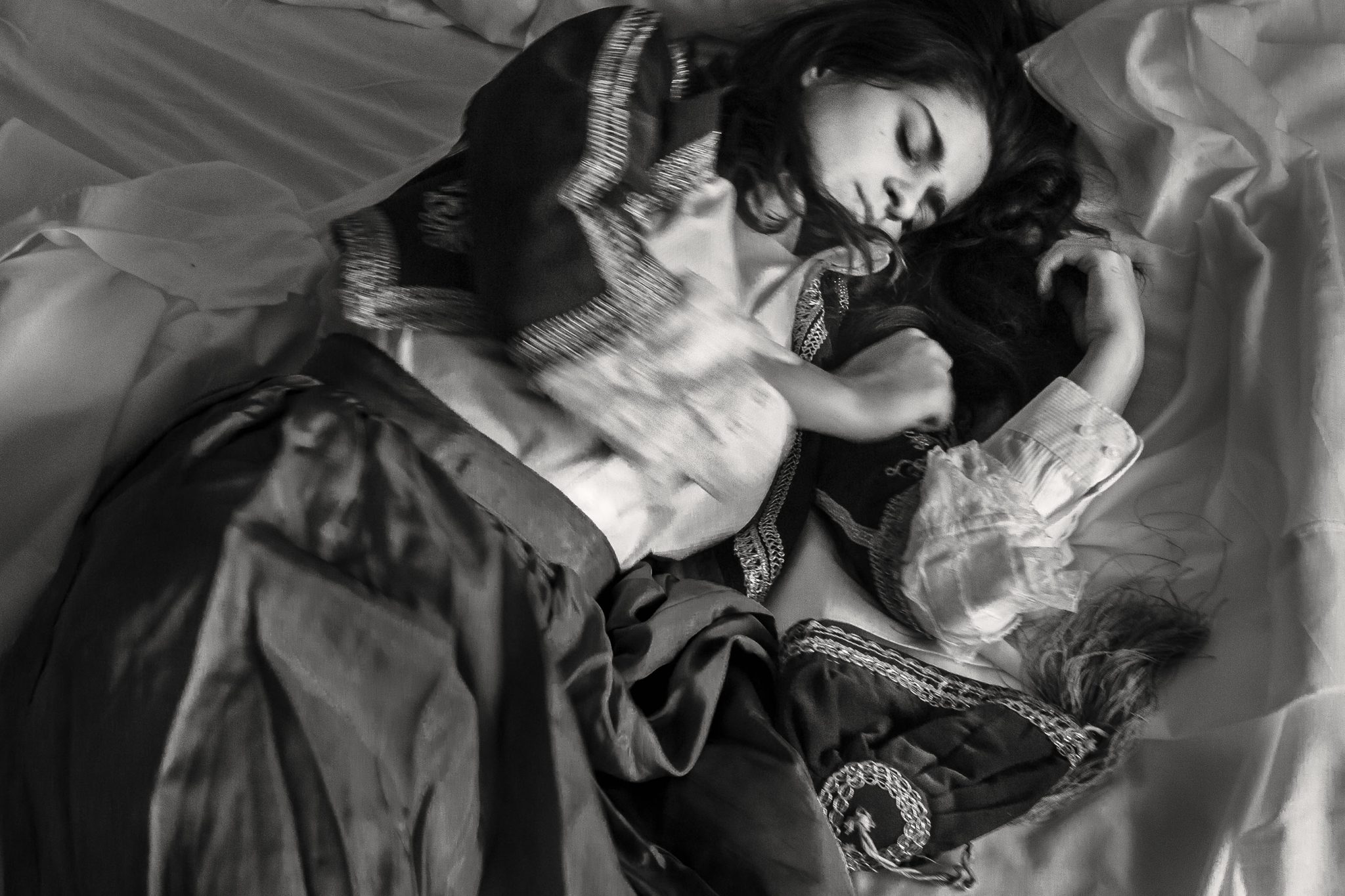
Price: $500
Heidi SeraphimWith a collage of photos, in this particular composition, I wanted to give emphasis on nature’s ability not to stop evolving and rising, despite the natural disasters or the human intervention. I aimed to point out nature’s identification with the human existence during and after covid.
Λουλούδια γυρεύαμε σε κήπους ξένους.
Εξωτικούς κοκοφοίνικες κ’ ανθισμένες μπουκαμβίλιες
Και δεν είδαμε πως η δική μας η αυλή είχε πάρει να μαραθεί.
Στην φορμόλη να κολυμπούνε οι μνήμες
και τα άνθη να επιπλέουν σε μια λίμνη μακρινή.
Σ’ ένα βάζο σφάλισες τ’ αρώματα,
Για να μαγειρεύεις (?) σε δύσκολους καιρούς.
Και όταν τα μάνταλα άνοιξαν,
δεν ήξερες κατά που να κινήσεις.
Ήταν μόνο η αρχή της μεταμόρφωσης, άκουγες.
Η φύση όμως ξέρει καλά, όσα εσύ λησμονείς.
Τώρα στάζει πορφύρα και γαλάζιο στο μουντό γκρι
και ας κρατάς ένα ρολόι που ο Χρόνος θαρρείς και κατάπιε τη Λήθη.
Η μεταμόρφωση έχει αρχίσει.
We were seeking for flowers in foreign gardens…
exotic coconut trees and blooming gardenias,
without noticing that our courtyard had begun to wither.
Memories are swimming in the odour of formalin
and flowers are floating in a distant lake.
You trapped the aroma in a crystal jar,
With the wistful longing to a safe companion in difficult times.
And when they unlocked the latches,
you couldn’t move…
‘It is just the beginning of the metamorphosis’ they whispered.
But nature speaks well the poem you have long forgotten.
Look how scarlet and light blue are now dripping on the hazy gray palette
Let go of the watch that you harbour,
as if the Time has swallowed the Oblivion.
The metamorphosis has started.
Look.

Tina SiderisAs a photographer I wanted to add to the In-Isolation exhibit for a few reasons. Mostly just to document something from this pandemic period in my own way. Also, to express and share something about how it might be affecting others. Originally, the inspiration was to highlight the effect of isolation on the elderly who are already within a stage of isolation, in age and living remotely with little connection and understanding as they approach the ‘end’ so to speak. I wanted to connect this aspect of their isolation and the current situation affecting all of us now. However, things changed so that the plight of being creative and the general stress and difficulty of living with imposed isolation on a person or a family became the theme of my images. Being ‘In Isolation’ detracts from being able to create and live freely, as separation means a kind of social death and thwarts the flow of new ideas. In this Isolation, the outside world is filled with anxiety and stress and immediate danger. Connecting with the world around us now is less possible, being distanced from it and ‘In-isolation’ is the new abnormal way to be.

Follow Tina Sideris
Kalliroe TsiatisIs freedom and social cohesion the purpose of change?
Any transition, serious enough, alters the definition of self.
It delves into raw truths to built identity, pride and cohesion.
To quote Albert Camus, “ More and more, revolution are found delivered
into the hands of its bureaucrats and doctrinaires as well as enfeebled
masses”.
